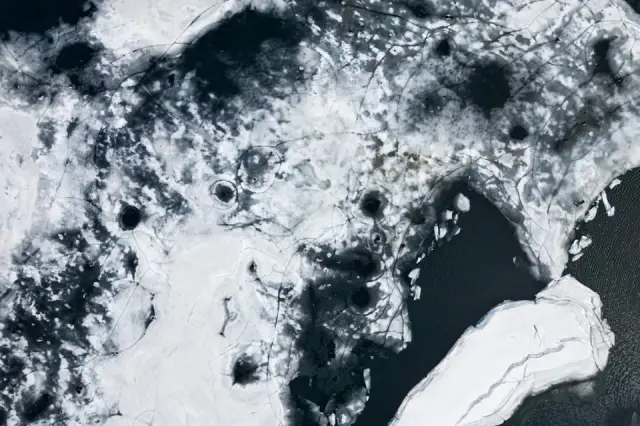
Unprecedented Ice Loss in the Bellingshausen Sea
Satellite observations reveal that the Bellingshausen Sea, on the west side of the Antarctic peninsula, is almost completely ice-free in June—a time when sea ice should be expanding rapidly toward its September peak. Scientists estimate the region is missing about 650,000 square kilometers (250,000 square miles) of sea ice compared with the 1991–2020 average. That area is roughly the size of France and nearly ten times the size of Tasmania.
Dr. Will Hobbs, an Antarctic sea ice expert at the University of Tasmania with the Australian Antarctic Program Partnership, described the situation as “depressing.” He noted that this is the third time in four years that sea ice has been very low in the region. “I don’t think we will see sea ice there any more. It’s done,” he said.
Why This Matters: Impacts on Wildlife and Glaciers
The loss of sea ice has direct consequences for marine life. Krill, a critical part of the food web, typically hide from predators under the ice in winter, grazing on algae. Without ice, their survival is threatened. Dr. Peter Fretwell, a scientist at the British Antarctic Survey who has been documenting penguin decline, said the current ice loss is “a serious problem for penguins, especially emperors.” He explained that sea ice is forming too late and breaking up too early, leading to reduced breeding success and longer trips to moulting grounds.
In late 2022, thousands of emperor penguin chicks died in a “catastrophic breeding failure” in four colonies along the Bellingshausen Sea coastline. That event contributed to the species being reclassified as “endangered” on the international threatened species list earlier this year. Adelie penguin numbers are also falling, and crabeater seals are being forced to migrate in summer to find stable ice.
Dr. Phil Reid, who monitors Antarctic conditions at Australia’s Bureau of Meteorology, pointed out that just to the west of the Bellingshausen Sea lie the Pine Island and Thwaites glaciers—the continent’s major contributors to ice loss and sea level rise. Floating ice shelves in front of these glaciers could break up faster if protective sea ice is absent for longer periods, potentially speeding up ice loss from the glaciers and pushing up global sea levels in the future.
Extreme Temperature Spike Linked to Missing Ice
This month, the Antarctic peninsula experienced an extreme temperature spike over several days. Officials at Argentina’s national weather service, Servicio Meteorológico Nacional, reported that the country’s Esperanza base at the peninsula’s northeastern tip recorded an “extreme temperature event” peaking on 5 and 6 June. Maximum temperatures of 15.4°C and 13.4°C were recorded, compared with average daily maximums of -6.2°C. The previous June record at the base was 13.3°C, set on 12 June 1998.
Dr. Hobbs said that while “nobody has done the numbers,” it is reasonable to suggest the heatwave was “made worse by the lack of sea ice.” Sea ice would usually help cool any warmer airflow entering the region from the north.
What Researchers Say Next
Scientists are trying to understand whether global heating is a factor in the persistent ice loss. Hobbs noted that the loss of sea ice is likely linked to changes in the ocean. The region has seen “incredible coastal exposure” in winter and summer in recent years, according to Reid. As of 10 June, total sea ice around Antarctica was about 11.4 million square kilometers, compared with a long-term average of 12.6 million square kilometers for that date. Researchers will continue to monitor whether the Bellingshausen Sea can recover or if this marks a permanent shift.
Report based on information from The Guardian.