A Monumental Journey
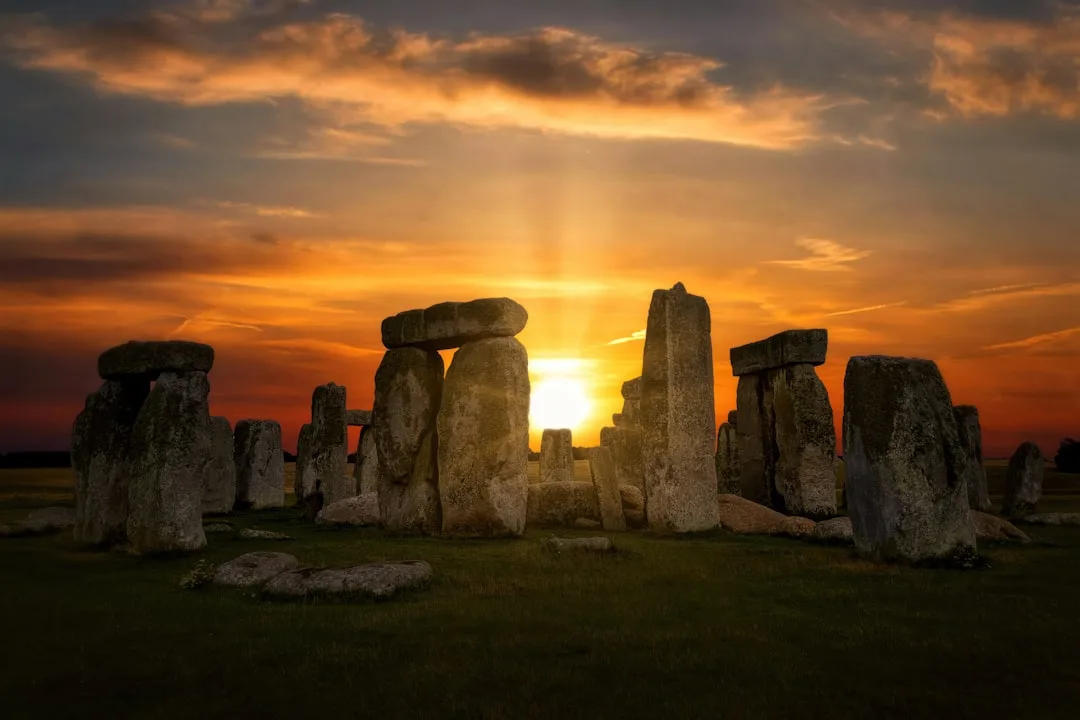
Stonehenge, the iconic prehistoric monument, has long puzzled researchers with its massive stones, particularly the Altar Stone, a six-tonne sandstone slab at its center. One of the enduring mysteries is how this stone made its way from northeast Scotland to Salisbury Plain in southern England, a journey of over 700 kilometers. Recent research suggests that glaciers played a crucial role in transporting the Altar Stone part of the way, with Neolithic people completing the journey.
Scientists from Sheffield Hallam University and Curtin University in Australia have proposed that a glacier carried the Altar Stone from the Orcadian Basin in northeast Scotland to Dogger Bank during Britain's last ice age, between 33,000 and 11,700 years ago. Dogger Bank, now submerged beneath the North Sea, was once part of Doggerland, a vast prehistoric landmass connecting Britain to mainland Europe. This discovery sheds light on the possible methods used to transport such massive stones over long distances.
Why it matters
The significance of this finding extends beyond the mere transportation of a large stone. It suggests that the people of Doggerland may have attributed cultural importance to the Altar Stone long before it became part of Stonehenge. This implies a level of cultural continuity and significance that spans thousands of years, highlighting the enduring importance of this monument in human history.
Dr. Remy Veness, co-lead author of the study, emphasized the cultural significance of the Altar Stone. "The Altar Stone must have been significant enough [for people] to be willing to move the stone at least twice; first to save it from being submerged by rising sea levels at the end of the last ice age and then again to its final resting place on Salisbury Plains," he said. This indicates that the stone held considerable value for ancient communities, prompting them to undertake the arduous task of moving it over great distances.
Background and Context
Stonehenge, constructed around 5,000 years ago, has been the subject of numerous studies and theories. The Altar Stone, lying at the heart of the monument, has been traced back to northeast Scotland. However, the method of its transportation to Salisbury Plain has remained a mystery. Previous theories have suggested human effort alone, but the recent study introduces the role of glaciers in this monumental task.
The research, published in the Journal of Quaternary Science, combines geological and archaeological evidence to propose a plausible scenario. The study suggests that glaciers carried the Altar Stone as far as Dogger Bank, leaving Neolithic people to transport it the rest of the way to Stonehenge. This theory is supported by the lack of natural stone sources in the Dogger Bank area, indicating that any large stones found there must have been transported by glaciers.
What happens next
The next step in this research involves further investigation into the specific routes and methods used by Neolithic people to transport the Altar Stone from Dogger Bank to Salisbury Plain. Researchers plan to explore the possible overland, coastal, and river routes that could have been utilized. This will involve detailed geological and archaeological surveys to identify potential pathways and evidence of human activity along these routes.
Additionally, the study opens up new avenues for understanding the organizational and cooperative capabilities of Neolithic communities. The feat of moving such a massive stone over long distances suggests a level of planning and coordination that was previously underappreciated. Future research will aim to uncover more about the social structures and cultural practices of these ancient communities, shedding light on their way of life and their relationship with monumental structures like Stonehenge.
This discovery also invites comparisons to other monumental structures around the world, such as the pyramids of Egypt. Just as the transportation of the Altar Stone required significant effort and coordination, the construction of the pyramids involved the movement of massive stones over long distances. These parallels highlight the universal human endeavor to create enduring monuments, regardless of geographical or temporal boundaries.
Original reporting by BBC Science Focus Magazine.