The limits of data in a crisis
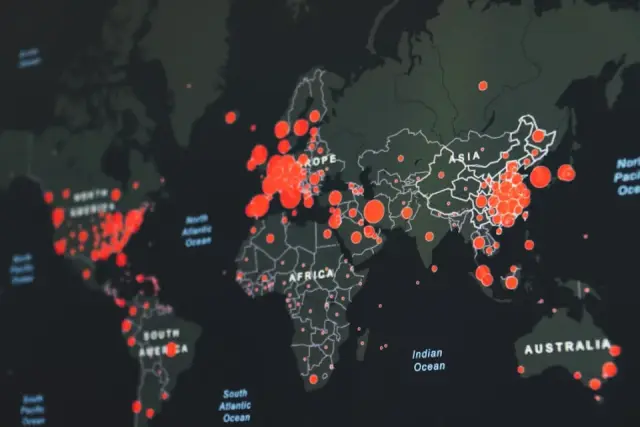
Two unfolding outbreaks continue to command global attention. As a hantavirus outbreak tied to a cruise ship appears to be petering out, Ebola cases continue to mount in Africa. Alongside them have emerged familiar artifacts of the Covid era, including dashboards, trackers, maps, risk estimates, and a polarized mix of alarming and dismissive takes. Once again, we’re able to watch disease spread in almost real time. Yet despite all the information, many people are left asking the same questions: what can I trust? How bad is this, really? What should I do? It’s a lesson we still haven’t fully absorbed: data doesn’t speak for itself.
Rewind to 2014, when the last major Ebola outbreak dominated headlines. Most of us encountered that crisis through journalists and public health officials who helped us interpret complex information. These experts provided important details. They acknowledged caveats. They connected relative risks to appropriate actions. By 2020, those supports were already weakening. The Covid-19 pandemic turned millions of people into direct consumers of data dashboards, statistical models, and risk calculations. The Johns Hopkins dashboard alone received billions of data requests a day. The pandemic also turned social media into a machine for stripping numbers of context and recirculating them as certainty. We had never had more access to information, or less help making sense of it.
How the information infrastructure collapsed
Since then, the interpretive infrastructure has only continued to fragment and collapse. Deep cuts at the CDC, HHS and NIH, plus the dismantling of USAID and our country’s withdrawal from the WHO, have undermined systems that track and respond to infectious disease. Less discussed is the parallel gutting of communication capacity within those organizations and the concurrent demise of local and national newsrooms. The US newspaper industry has lost more than three quarters of its jobs in the past two decades. As those channels have eroded, people have grown more reliant on rapid, context-thin streams of information on social media feeds and AI-generated summaries. Social media rewards certainty, not the nuance of relative versus absolute risk or the transmission dynamics of a virus. AI’s confident-sounding summaries may, too, omit the very caveats that determine whether a statistic is meaningful or misleading.
This problem runs deeper than conspiracy theories, although a vacuum of trustworthy information does give misinformation room to spread. There’s no returning to the old media landscape. But some of what’s been lost can be restored. Investing in original reporting is a necessary foundation. As the New York Times publisher AG Sulzberger recently argued, AI products rely on journalism. Without strong reporting, they will eventually have little of value to synthesize. Communication teams need rebuilding, too. One underappreciated consequence of US withdrawal from the WHO is that we stepped away from one of the world’s primary efforts to coordinate health messaging. And we reduced its capacity for everyone. Before ties were cut, the WHO had begun partnering with platforms such as TikTok to reach wider audiences.
Why context and caveats matter
Even with ample words or minutes of video, framing shapes what people understand – and misunderstand. Distortions can take different forms, such as missing context that reverses a finding, definitions that subtly shift, and labels that project confidence not supported by the underlying numbers. During Covid, some messengers cited data showing higher death rates among vaccinated people than unvaccinated people. Obscured was the fact that older adults were both more likely to be vaccinated and more likely to die from Covid. The relationship reversed once the data was broken down by age. Early hantavirus statistics carry a similar blind spot. Commonly cited death rates of 30% to 40% may overstate the true risk, since milder infections may go undiagnosed and shrink the denominator.
Geography can disappear from the picture, too. A region may hit the vaccination threshold for herd immunity on paper while unprotected pockets within it act as kindling, letting a virus spread between vulnerable clusters. Scientists believe this local variability is driving measles resurgence. Yet that nuance rarely reaches the public, potentially leaving people with a false sense of security. Framing can also project false certainty. In January 2020, the WHO tweeted that preliminary investigations from China suggested no clear evidence of human-to-human transmission – a statement that later proved incorrect and contributed to early confusion.
What researchers say next
Today’s high-profile outbreaks will eventually fade. But more are coming. Researchers put the odds at greater than one in five for another pandemic killing at least 25 million people within the next decade. Meanwhile, we’re already dealing with persistent measles outbreaks across parts of the US and the world – a disease so contagious that nine out of 10 unvaccinated people exposed will contract it, and one for which we have effective prevention. The challenge there is largely one of communication. Preparing for future outbreaks will require not only containing viruses but managing the information environment around them. We’ve now accumulated more than enough lessons to draw from.
Scientists, doctors and other trusted voices can also do more to communicate directly with the public. We saw this work during Covid, when researchers used social media to walk people through concepts such as the logarithmic scale and “flattening the curve”. One study found that short videos by doctors and nurses ahead of the winter holidays reduced travel and subsequent Covid infections. Ultimately, it’s about meeting people where they are. At the center of the Ebola outbreak in the Democratic Republic of Congo, a radio station has dedicated daily programming to answering questions and correcting rumors about the virus, in hopes of winning over residents who’ve grown distrustful of authorities.
As reported by The Guardian.